
Centralized exchanges (CEX) rely on a central authority to manage trades, much like traditional stock markets. They offer user-friendly interfaces and high liquidity for fast transactions. In contrast, decentralized exchanges (DEX) operate without central control using blockchain technology. Users keep control of their assets and enjoy more privacy. While CEXs often have higher fees and security risks due to asset holding, DEXs offer lower fees but can struggle with liquidity. There’s more to explore about these differences.
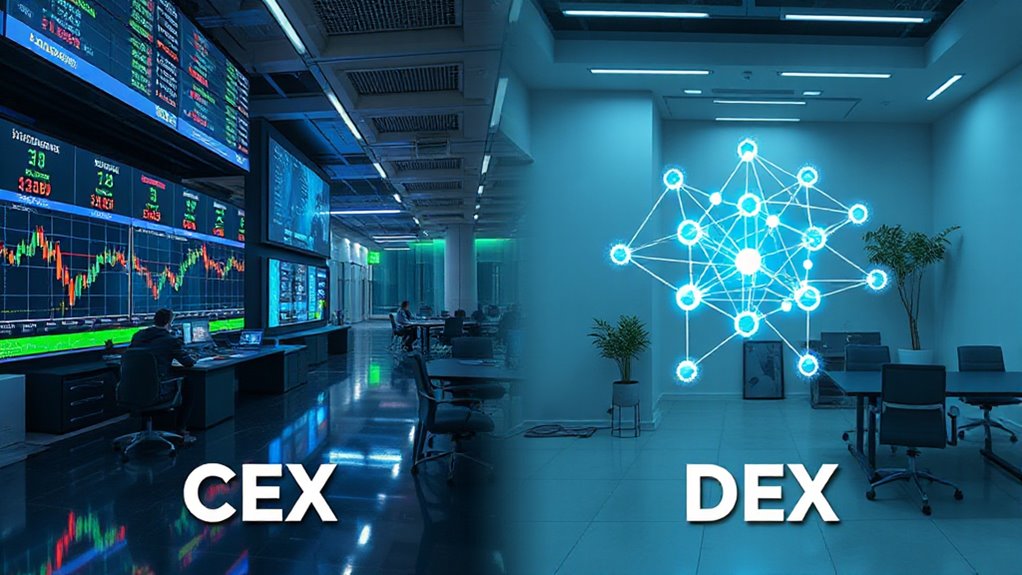
What’s the difference between centralized exchanges (CEX) and decentralized exchanges (DEX)? Centralized exchanges are platforms that allow users to trade cryptocurrencies but operate under a central authority. This means they manage transactions similarly to traditional stock exchanges.
On the other hand, decentralized exchanges function without a central control. They use smart contracts and blockchain technology to enable peer-to-peer trading. DEXs enhance security and privacy by ensuring users maintain control over their funds and private keys, which is a fundamental aspect of decentralized finance (DeFi).
One key difference lies in user autonomy. DEXs promote a greater sense of control, as users do not have to rely on a central authority. CEXs are often easier to use, making them suitable for beginners. They offer user-friendly interfaces and high liquidity, which means trades can be executed quickly. DEXs, however, cater to those who value privacy and decentralization. Additionally, CEXs provide higher liquidity, allowing for faster trade execution compared to DEXs. CEXs also offer a comprehensive suite of services, including borrowing and futures trading, which can enhance the trading experience for users.
User autonomy is a key distinction: DEXs offer control and privacy, while CEXs provide ease of use for beginners.
In terms of security, CEXs have inherent risks. Because they hold users’ assets, they can be vulnerable to hacking. DEXs, in contrast, allow users to maintain control over their assets, making them safer from large-scale hacks. This design is crucial in fostering a more secure trading environment.
While CEXs require identity verification, DEXs offer greater privacy, as they typically do not ask for personal information.
When it comes to liquidity, CEXs generally have higher trading volumes, allowing for efficient trades with minimal price impact. DEXs rely on liquidity pools, which can sometimes lead to lower liquidity and more significant price changes. This means large trades can have a noticeable effect on token prices on DEXs, particularly during periods of high demand.
Fees also differ between the two types of exchanges. CEXs usually have structured fees that can be higher due to their added services and regulatory compliance. DEXs tend to have lower platform fees, but users may still face blockchain transaction fees that vary with network conditions.
Frequently Asked Questions
Which Is Safer: CEX or DEX for Trading Assets?
When considering safety in trading assets, both Centralized Exchanges (CEXs) and Decentralized Exchanges (DEXs) have unique strengths and weaknesses.
CEXs are regulated and often provide customer support, but they face risks from hacking.
DEXs allow users to control their private keys, enhancing privacy, but users are responsible for their own security.
Each option has its own safety features, making it important for traders to weigh the risks based on their needs.
Can I Trade Fiat Currency on a DEX?
A decentralized exchange (DEX) doesn’t allow users to trade fiat currency directly.
Instead, DEXs focus on cryptocurrency trades between users. This means people can only swap one cryptocurrency for another.
To trade fiat, users typically need to use a centralized exchange first. There, they can convert fiat to cryptocurrency before transferring it to a DEX for trading.
This limitation is important for those looking to use traditional money on a DEX.
How Do Fees Compare Between CEX and DEX?
When comparing fees, centralized exchanges (CEXs) usually charge higher trading fees, ranging from 0.1% to 0.5% per trade.
They may also have extra fees for deposits and withdrawals.
In contrast, decentralized exchanges (DEXs) often offer lower or even zero trading fees.
However, users must pay network fees, which can be unpredictable.
For high-volume traders, CEXs might provide discounts, making them more appealing for larger trades.
What Happens if a CEX Gets Hacked?
When a centralized exchange gets hacked, users can face serious problems. Their funds may be lost, leading to financial losses.
The exchange might stop operations temporarily to investigate the breach. This can cause liquidity issues, making it hard for users to withdraw their money.
The hack can also lead to stricter regulations and damage the exchange’s reputation. Overall, such incidents can shake user trust and create instability in the cryptocurrency market.
Are DEX Platforms User-Friendly for Beginners?
DEX platforms can be challenging for beginners. They often require some knowledge of blockchain technology and cryptocurrency wallets.
The user interfaces are usually less friendly than those of centralized exchanges. Beginners might struggle with maneuvering these platforms and understanding smart contracts.
Additionally, DEXs lack customer support, leaving users to solve issues on their own. While they offer privacy and control, the complexity can deter new traders from using them effectively.