
The amount of hash power from crypto mining can vary widely. It depends on the type of hardware used, such as CPUs, GPUs, or specialized ASICs. ASIC miners often provide the highest hash rates and efficiency. Higher hash power increases the chances of earning rewards. However, mining costs like electricity can affect profits. Understanding these factors helps to grasp the mining process better. There’s more to explore about how mining works in today’s crypto landscape.
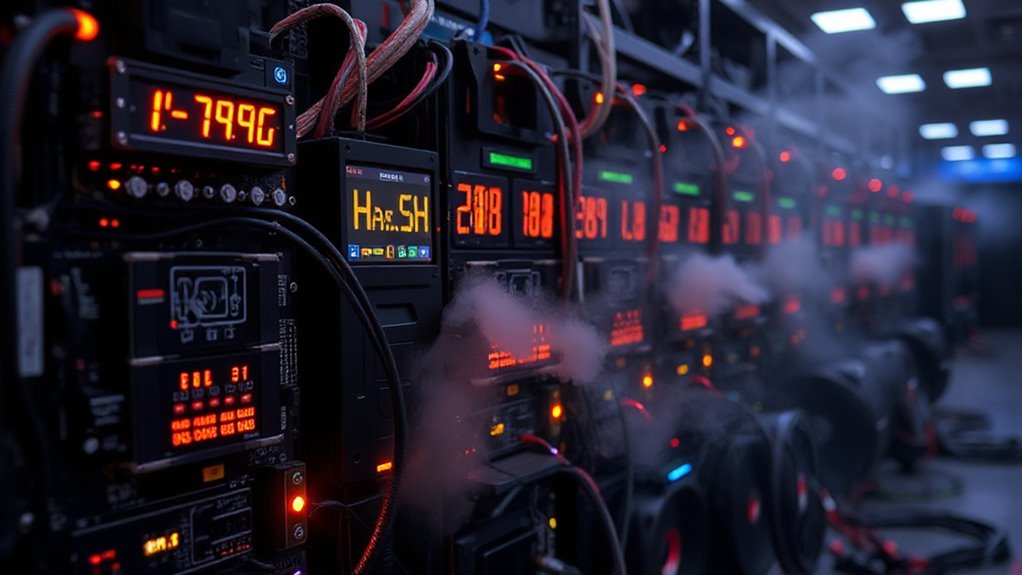
As the world of cryptocurrency grows, hash power has become a vital term in understanding how mining works. Hash power measures the computational strength of a blockchain network or individual mining devices. It’s often calculated in hashes per second, which can be expressed in various units like kilo (KH/s), mega (MH/s), and tera (TH/s). The higher the hash power, the more secure the network becomes. A higher hash rate indicates network security by reflecting increased miner participation and competition to add blocks.
Mining is a competitive process. Miners use different devices, such as CPUs, GPUs, and specialized ASICs, to find new blocks and earn rewards. ASIC miners are the most effective for this purpose, as they provide higher hash rates with less energy consumption. In contrast, CPUs and GPUs have lower hash rates and can be less efficient for mining tasks. This difference in technology impacts how much hash power a miner can produce. Proof-of-work consensus protocols are designed to ensure that miners compete fairly for rewards by adjusting mining difficulty based on total hash power. Additionally, cryptocurrency mining requires significant investment in hardware and energy resources, which can vary greatly depending on the chosen mining setup.
The amount of hash power a miner can generate affects their profitability. A higher hash rate increases the chance of solving a block first, which means bigger rewards. However, mining costs can be high. Expenses for electricity and hardware can eat into any profits a miner makes. In competitive markets, only the most efficient miners can stay profitable.
Hash power also plays an essential role in network security. A high hash rate makes it harder for bad actors to attack the network. When more miners join and contribute hash power, the network becomes stronger and more resilient. If the total hash rate increases, the difficulty of mining adjusts to keep a steady flow of new blocks.
Frequently Asked Questions
What Factors Influence the Profitability of Crypto Mining?
Several factors influence the profitability of crypto mining.
Hardware costs are high, especially for specialized machines known as ASIC miners. Electricity charges can also eat into profits, making cheap energy essential.
The price of Bitcoin plays a vital role; as it rises, so does mining profitability. Additionally, mining difficulty increases over time, requiring more power.
Market volatility can impact earnings, while mining pool fees and hardware depreciation also affect overall success.
How Do Mining Pools Affect Hash Power Distribution?
Mining pools affect hash power distribution by combining the efforts of many miners. This teamwork increases the chances of successfully finding new blocks.
As a result, pool members get more frequent payouts, though these are usually smaller since rewards are shared. Large pools often control significant portions of total hash power, which can raise concerns about centralization.
A balanced distribution of hash power is important for network security and fairness among miners.
Can Mining Hardware Be Upgraded for Better Performance?
Upgrading mining hardware can lead to better performance.
Newer models, like ASIC miners, offer higher hash rates and improved energy efficiency. This means they can solve complex problems faster while using less power.
Advanced cooling systems also help keep devices running smoothly.
By upgrading, miners can increase their chances of earning rewards and adapt to changing conditions in the cryptocurrency market.
Is It Legal to Mine Cryptocurrency in All Countries?
Cryptocurrency mining isn’t legal in all countries. In many places, it’s not banned but faces unclear rules.
Countries like the U.S. and Canada allow mining, though some states have their own regulations. The UK requires licenses for certain activities but doesn’t have specific mining laws.
In contrast, China has banned all cryptocurrency activities.
Meanwhile, countries like Georgia and Portugal offer friendly rules for miners, while others, like Australia, allow mining but don’t recognize cryptocurrencies as legal tender.
How Does Electricity Cost Impact Mining Profitability?
Electricity costs play a big role in mining profitability. They can make up to 80% of a miner’s expenses.
Regions with lower electricity rates, like Iceland, give miners an advantage. High energy costs force miners to find ways to save, like using efficient hardware or buying energy in bulk.
Renewable energy is becoming popular too, helping to lower costs and make mining more sustainable.