Mining Bitcoin involves using powerful computers to validate transactions and secure the blockchain. Miners need specific hardware, like ASICs, and mining software to guide their operations. They must compile transactions, create a Merkle root, and solve complex puzzles using the SHA-256 hashing algorithm. Miners work alone or in pools to increase their chances of success. Incentives include block rewards and transaction fees. There’s more to learn about the process and its requirements.
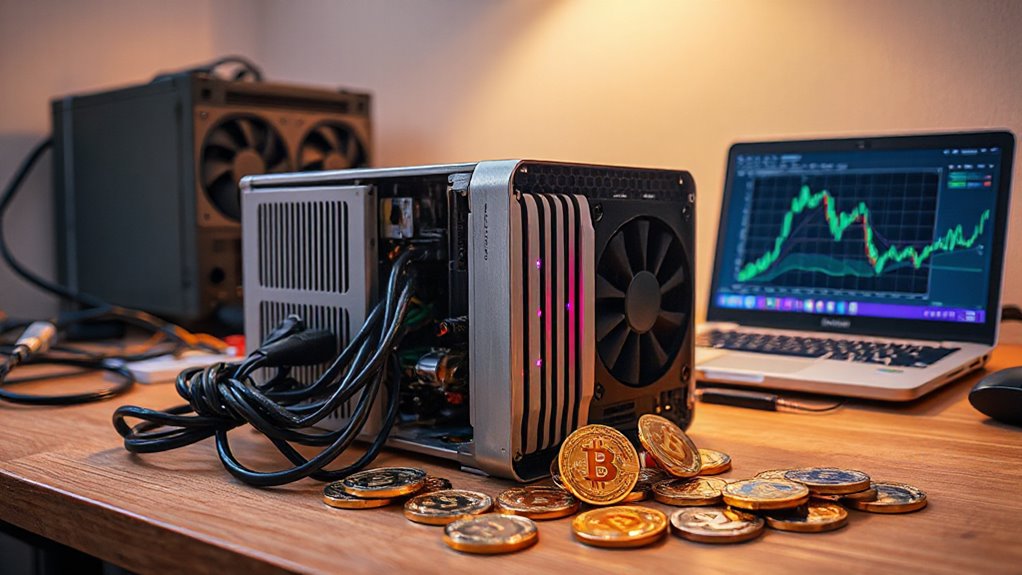
Bitcoin mining is the process where powerful computers validate transactions and secure the blockchain. This complex task involves solving a mathematical puzzle known as Proof of Work (PoW). Currently, miners receive a block reward of 6.25 BTC for each block they successfully mine.
To participate in mining, individuals need specific hardware, with Application-Specific Integrated Circuits (ASICs) being the most effective option. Other hardware choices like CPUs and GPUs exist, but they are less efficient. Mining software is essential for guiding the hardware and managing the mining process. Miners also need a reliable power supply due to the high energy consumption associated with mining. A fast and stable internet connection is important for efficient operations. Additionally, cooling systems may be required to manage the heat generated by the mining equipment.
To mine Bitcoin effectively, dedicated hardware like ASICs is essential, as CPUs and GPUs offer lower efficiency.
The mining process starts when miners compile transactions into a block. They then verify these transactions to confirm they are legitimate. A Merkle root, which is a hashed combination of transactions, is created next. Using the SHA-256 hashing algorithm, miners generate a block hash.
The Proof of Work is achieved when miners adjust a number called the nonce to find a hash that meets the network’s difficulty target. The first miner to produce a valid hash broadcasts the new block to the network. Transaction verification is crucial as it ensures the legitimacy of transactions, preventing double-spending. Furthermore, miners utilize mining pools to collaborate and increase their chances of successfully mining blocks. This collaboration helps to enhance the decentralization of the network, making it less susceptible to control by a single entity.
Mining also plays a significant role in securing the blockchain. Each transaction must be validated to maintain the network’s integrity. The block rewards incentivize miners to participate and secure the network. Miners and nodes reach a consensus on the blockchain state, confirming everyone agrees on the transactions.
Despite the high energy use, the complexity of PoW helps protect the network from attacks. Incentives for miners include block rewards and transaction fees. Miners compete to solve the PoW puzzle first, making profitability a key focus.
Halving events occur about every four years, reducing block rewards to control the supply of Bitcoin.
Frequently Asked Questions
What Is the Environmental Impact of Bitcoin Mining?
Bitcoin mining has a significant environmental impact. It consumes about 63 terawatt-hours of energy each year, which is similar to a country’s energy needs.
This process releases around 86 megatons of CO₂, mainly from fossil fuels. Mining also contributes to air pollution, exposing millions to harmful particles.
Additionally, it uses a large amount of water and land, raising concerns about resource strain and environmental damage in mining regions worldwide.
Can I Mine Bitcoin on My Smartphone?
Mining Bitcoin on a smartphone is technically possible, but not practical.
Smartphones don’t have the powerful hardware needed to compete with specialized machines called ASICs. These machines are much more efficient at solving the complex problems required for mining.
Additionally, mining can cause smartphones to overheat and damage their batteries.
Many apps claiming to allow smartphone mining are scams, misleading users with false promises of profits and exposing them to security risks.
Is Mining Bitcoin Still Profitable in 2023?
In 2023, Bitcoin mining remains profitable, but it’s more challenging. The market value of Bitcoin rose, boosting profits. However, mining difficulty also increased considerably, making it tougher for miners.
The global hash rate grew dramatically, leading to more competition. High electricity costs have pressured many miners to sell their Bitcoin to cover expenses.
What Hardware Is Best for Bitcoin Mining?
When it comes to Bitcoin mining, the best hardware includes ASICs, which are more efficient than GPUs.
Leading models like the Bitmain Antminer S21 Hyd and Antminer S19 XP Hyd offer high hash rates and advanced cooling systems.
The MicroBT Whatsminer M50S and M56S also provide competitive performance.
Energy efficiency is essential, as lower power consumption helps increase profitability and reduce environmental impact in this growing industry.
How Do Mining Pools Work for Bitcoin?
Mining pools for Bitcoin are groups where miners combine their computing power. This teamwork helps them solve puzzles faster, increasing their chance of earning rewards.
Each miner contributes their hash power, and rewards are shared based on that contribution. Pool managers assign tasks and track progress.
While mining pools offer better chances for smaller miners, they also come with risks, like security concerns and fees that can reduce overall earnings.