AVAX is the native cryptocurrency of the Avalanche blockchain, launched in 2020 by AVA Labs. It aims to solve the blockchain trilemma of decentralization, scalability, and security. The system consists of three main chains: X-Chain for asset creation, C-Chain for smart contracts, and P-Chain for consensus. AVAX has a capped supply and is used for network governance. It supports various applications, including DeFi and NFTs. There’s much more to discover about this evolving ecosystem.
As blockchain technology continues to evolve, AVAX has emerged as a key player in the cryptocurrency space. AVAX is the native cryptocurrency of the Avalanche blockchain. It plays a crucial role in transaction fees, governance, and staking rewards. Launched in 2020 by AVA Labs, founded by Emin Gün Sirer, Avalanche aims to tackle the blockchain trilemma. This trilemma focuses on finding a balance between decentralization, scalability, and security.
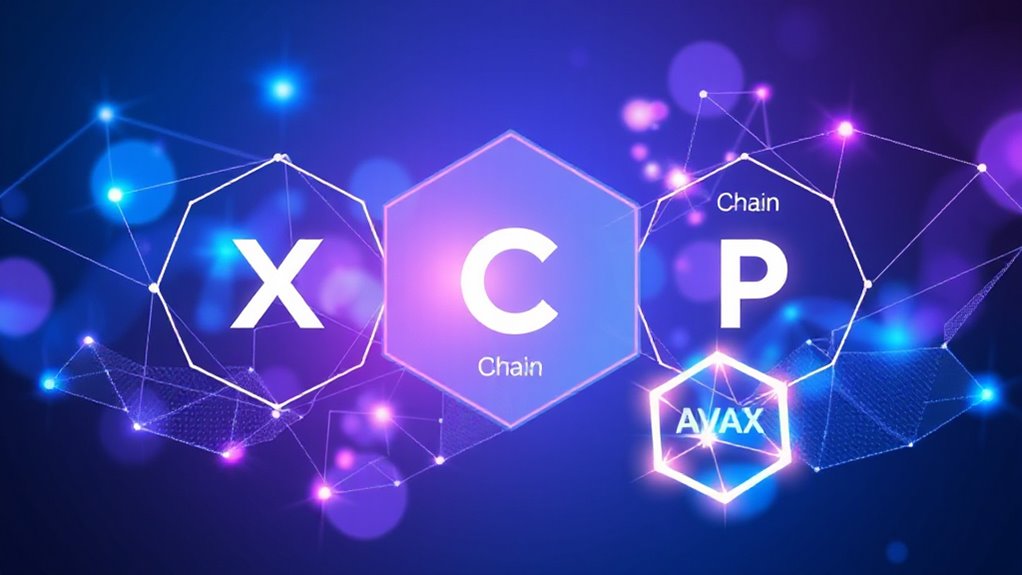
Avalanche operates through a unique setup called a network of networks. It has three main chains: the X-Chain, C-Chain, and P-Chain. The X-Chain is for creating and exchanging assets. The C-Chain allows users to run smart contracts based on Ethereum’s technology. The P-Chain handles consensus and allows the creation of subnets. Subnets are special blockchains that can define their own rules. Validators need to stake AVAX to take part in the network’s operations and governance. Additionally, Avalanche’s transaction processing speed allows it to handle up to 4,500 transactions per second, significantly outperforming Bitcoin and Ethereum. The platform’s consensus mechanism ensures that validators reach agreement through a sampling process, enhancing security and efficiency. Notably, Avalanche is known for its interoperability features, allowing different blockchains to communicate seamlessly.
The tokenomics of AVAX is interesting. It has a capped supply of 720 million tokens. Half of these were created at the launch, while the rest come from staking rewards. All transaction fees on the network are burned, which reduces the number of circulating tokens over time. This burning process increases the scarcity of AVAX. It also serves as a governance tool, letting holders vote on important network decisions.
The Avalanche ecosystem is bustling with activity. It supports decentralized finance (DeFi) applications and platforms like Aave and Curve. The platform is known for its fast transaction speeds, achieving finality in under one second. This is much quicker compared to other blockchains. Additionally, it allows for the development of non-fungible tokens (NFTs) and blockchain games.
Frequently Asked Questions
How Do I Store My AVAX Safely?
To store AVAX safely, users have several wallet options.
Hot wallets are convenient for quick transactions, while cold wallets offer better security by being offline.
Hardware wallets combine security and ease of use, while paper wallets are physical copies of keys.
It’s important to back up wallet information and use two-factor authentication.
Staying aware of phishing scams and regularly updating software can help protect assets from unauthorized access.
Can I Earn Interest on My AVAX Holdings?
Yes, it is possible to earn interest on AVAX holdings. Users can stake AVAX, which may yield rewards as high as 54% annually.
Some platforms also offer interest rates up to 14% on AVAX after promotional periods. Additionally, platforms like Nexo allow users to earn interest directly.
However, the interest earned can depend on factors like the amount staked and the platform’s specific terms and conditions.
What Are the Transaction Fees for AVAX?
Transaction fees on Avalanche vary based on network demand. They can range from 75 to 225 nAVAX, with a minimum base fee of 25 nAVAX.
Fees are paid in AVAX, which is burned to help reduce its supply. Users can adjust their fees during transactions.
When the network is busy, fees increase, while they decrease during quieter times. Understanding these fees is important for users to guarantee successful transactions.
Is AVAX Environmentally Friendly?
Avalanche is considered environmentally friendly.
It uses a proof-of-stake system, which is much more energy-efficient than the proof-of-work systems used by Bitcoin and Ethereum.
Avalanche’s annual energy consumption is around 469,802 kWh, considerably lower than that of its competitors.
Its carbon emissions are minimal, equivalent to just 29 roundtrip flights from Munich to San Francisco.
This low impact makes Avalanche a popular choice for projects focused on sustainability.
How Does AVAX Compare to Ethereum?
Avalanche and Ethereum differ markedly in speed and costs.
Avalanche can handle 4,500 to 6,500 transactions per second, while Ethereum processes about 15. Transactions on Avalanche finalize in under a second, compared to Ethereum’s 10 seconds to several minutes.
Transaction fees on Avalanche are low, usually between $0.01 and $0.08, whereas Ethereum’s can soar over $100.
Both platforms support smart contracts, but Avalanche allows for more customization in its blockchains.