
In recent years, trading bots have become a significant part of financial markets, changing how trades are made. These automated systems can execute trades much faster than human traders, processing vast amounts of data in mere milliseconds. This speed allows bots to take advantage of market opportunities that human traders might miss. Unlike humans, trading bots make decisions based on logic, free from emotions like fear and greed.
Trading bots can operate continuously, 24/7, ensuring they never miss a trading opportunity. This constant monitoring leads to increased efficiency in the market. Various types of bots serve different strategies. For example, trend-following bots capitalize on ongoing market trends, while mean reversion bots profit from price fluctuations by buying low and selling high. Arbitrage bots exploit price differences across markets, making risk-free profits. Scalping bots focus on quick trades to capture small price movements, while market-making bots provide liquidity by profiting from the bid-ask spread. Algorithmic trading bots are becoming indispensable tools for traders and institutions alike.
Trading bots work around the clock, employing diverse strategies to optimize market efficiency and capitalize on trading opportunities.
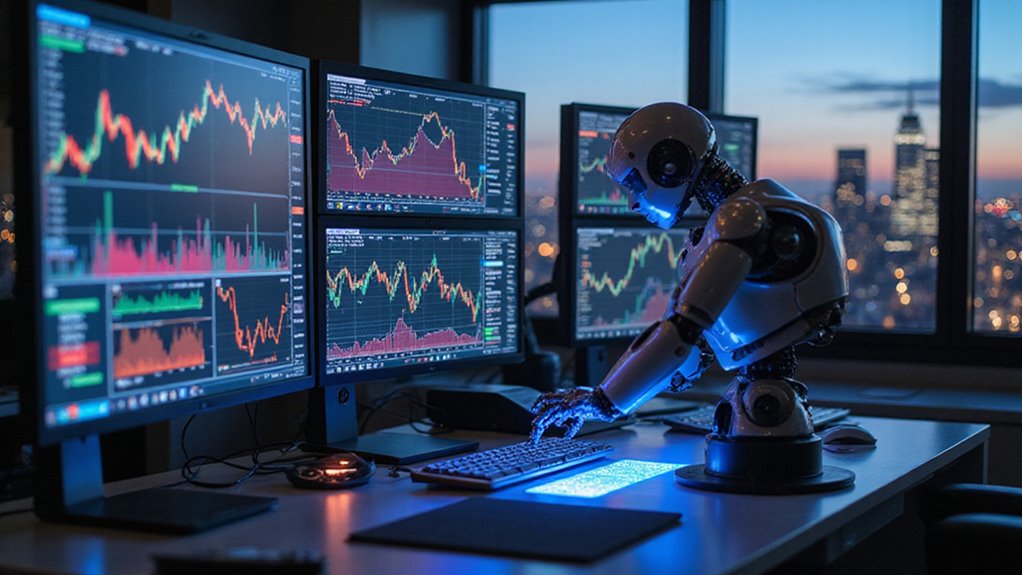
Advanced machine learning algorithms are key features of these bots. They help identify profitable trading opportunities and analyze the market in real time. With automated risk management tools, bots can minimize potential losses by setting stop-loss and take-profit orders. Their high-speed execution allows them to react quickly to market changes, often outperforming human traders. AI-driven automation provides significant advantages in financial markets, further enhancing the effectiveness of trading bots.
The impact of trading bots on market dynamics is significant. They increase market liquidity by executing trades at higher frequencies, contributing to more stable conditions. In volatile markets, bots can stabilize prices, acting when human traders might hesitate. However, there’s a need for caution. Reliance on bots without oversight can lead to losses in unpredictable situations.
Despite their advantages, trading bots are not infallible. Some algorithms may struggle with sudden market changes, and ethical concerns arise regarding manipulative practices. Nonetheless, as technology evolves, smart traders increasingly trust bots to handle their trades, often finding success in doing so.